Field Note 03 · Tech Events & AI
Birmingham Tech Week 2026: what I took away
Two days at the ICC, and one idea that ran through both of them: the people who use what we build will soon send their AI to do it for them.
· 9 min read · by Hadi Vahidi
Birmingham Tech Week ran from 19 to 23 October under the theme "Fast Forward". By the organisers' count afterwards, that came to 12 main events, dozens of fringe events, more than 200 speakers and delegates from 19 countries. On the Monday morning, TechWM's chief executive, Andy Hague, told the opening Leadership Breakfast that "there is no longer such a thing as a non-tech business".
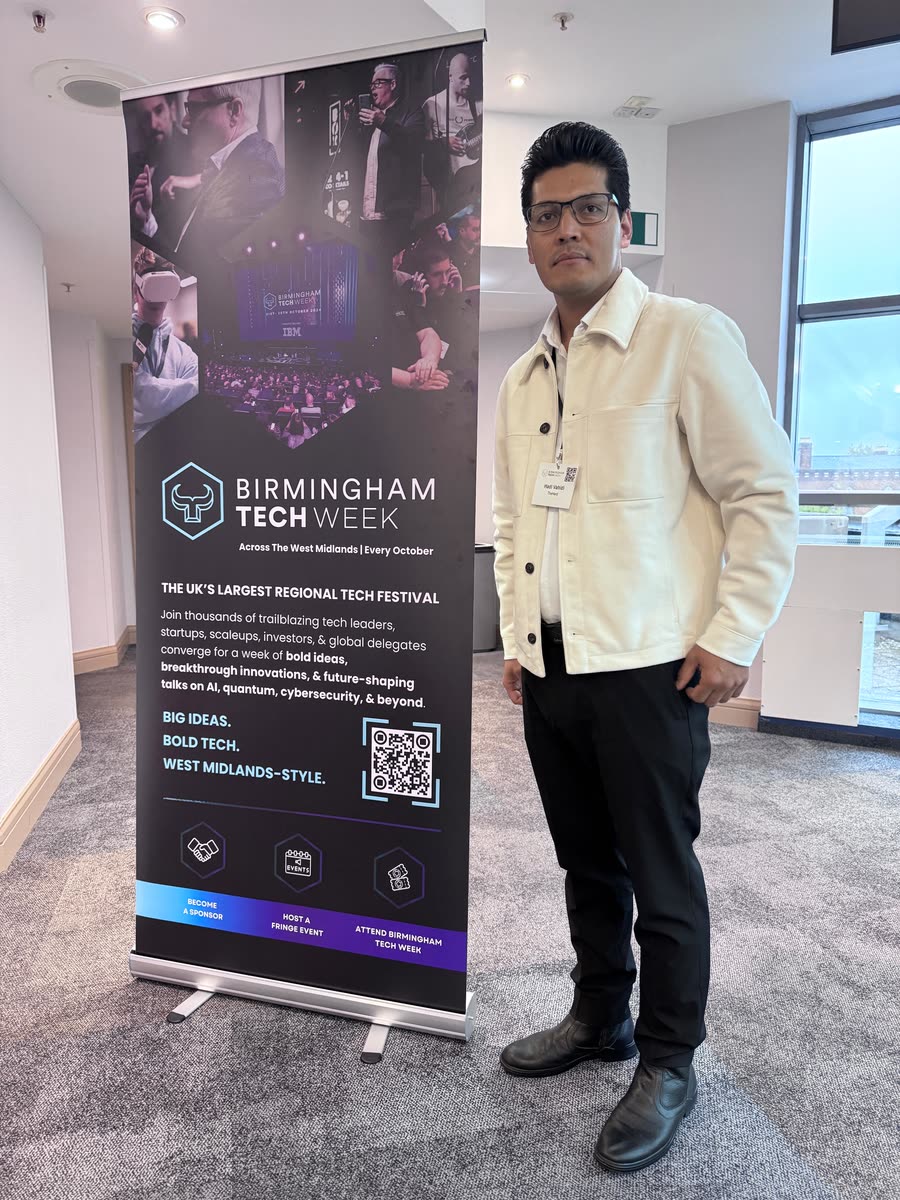
I spent Wednesday and Friday at the ICC: the AI Symposium on Wednesday and the Engineering & Developer Conference on Friday. This is what stayed with me, written for people who build websites, booking systems and the APIs behind them. Where I quote someone, the words come from their own slides or their own posts.
01 Your customers will bring their own AI
Tom Loosemore opened the AI Symposium. He is a founding partner of Public Digital and one of the people behind GOV.UK, and he said afterwards that, as a Brummie, giving this one at home was "so much fun".
His talk was called "How to surf an agentic AI tsunami", and he built it as ten tips for handling what he called AI vertigo. He opened in 1983 ("the BBC made me a computer...", over a photo of a classroom of BBC Micros), jumped forward 43 years and admitted: "I've never been more excited (or terrified)."
The first tip set up everything else: "AI chatbots answer your questions. AI agents take action on your behalf." If he is right that agents "could herald as big a change as the internet", the interesting question is not what your organisation does with AI. It is what happens when your customers turn up with it.
That was his fourth tip, and the one I keep coming back to: "How your customers use AI will matter more than how your own organisation uses AI." He called the usual approach looking down the wrong end of the telescope.
"How do we use AI to deliver services more efficiently?"
"What happens when citizens use AI to engage with our services?"
The sixth followed from it. Friction no longer constrains demand, and in the words of the slide, "'Managing demand' by making it hard, boring or slow to apply for stuff is doomed." If an agent will happily fill in the long form, the long form stops protecting anyone. His answer was to move to proactive, data-driven services.
I build booking systems and client portals, so this one landed close to home. Plenty of booking flows lean on friction to protect a diary: a long intake form, appointments by phone only, a deposit to put off casual bookings. Once someone's assistant can get through all of that at midnight without complaint, the friction filters nobody. The rules have to live in the system instead, as real availability and a cancellation policy the software actually enforces.
The rest, briefly:
- A revolution like this comes in two waves. The first improves how an organisation does what it already does; the second reinvents what it does around people's new habits, and "surfing the second wave matters most". His example was the BBC, which missed the second wave of digital "even though they saw it coming". A later slide put Ofcom's 2025 figures beside it: among 16 to 34-year-olds, YouTube took 23% of the time spent watching video at home and the BBC took 6%.
- Watch how people's expectations and behaviour change more closely than you watch the technology.
- The impact won't be even. The more a service runs on information, the bigger the likely disruption.
- AI amplifies the way you already work. "Great teams get superpowers", while dysfunctional organisations "get tied in knots". "So stop the Copilot cosplay."
- Optimise for awareness and adaptability, above efficiency.
- "Play. With. This. Stuff." He clearly does: his slides showed a benefits calculator he made in February, with its own API and two chatbots, and WhenIsBins.com, a bin-day service from September that publishes a guide written for AI agents.
- "If in doubt, be bold. The window for boldness will close."
My favourite line was an aside on one slide:
"AI agents will join up government long before government joins up government."
02 From pilots to practice
The symposium's brief was getting organisations past experiments and into real use, and the two morning panels came at that from different sides.
The first, chaired by Aaron Powell of the West Midlands Combined Authority, put Phil Rumens of the Government Digital Service, Kat Sexton of MHCLG and Martin Sadler of Birmingham City Council on stage with Amardeep Gill of Trowers & Hamlins. Gill's own framing that morning was public service transformation, procurement, governance and accountability, at a time when AI "increasingly moves from providing insight to taking action".
The second, "Agents: Mind the Gap", was chaired by Professor Elena Gaura of Coventry University, with panellists including Yiannis Maos of Unloq, Kirti Desai and John Faria of SCC. The question on the programme was how governance, workforce design, procurement and risk change once agents start taking part in buying.
The afternoon was billed as "AI in Action", and the demos on the programme were local and specific. Transport for West Midlands and VivaCity were down to show computer vision that counts traffic and helps plan for walking and cycling. WM5G had Birmingham's community colon capsule endoscopy service, which uses digital tools to flag risk earlier, and B13 was introducing the West Midlands Digitalisation Programme. That is where AI earns its place or doesn't: at a road junction, or in a clinic.
03 Next door: Frontiers Day
The same day, in the same building, BOM (Birmingham Open Media) ran Frontiers Day, the creative strand of the week. Lara Jeetley, a young researcher at the Alan Turing Institute, gave the keynote and, in BOM's words, made the case that in the age of AI "the future belongs to the generalist". As someone who designs as well as codes, I'll take that.
The panel on designing for the attention economy brought together Eloise Singer of Singer Studios, Vicki Sutherland of Outernet and Jordan Prince of Netflix, chaired by Mikayla Sinead. Outernet came away with a line I would happily pin above any product team: "Technology should enable the magic, not be the magic."
Outside in Centenary Square stood the week's unofficial mascot. Faster Horse is a six-metre inflatable by the Midlands artist Bruce Asbestos, commissioned by BOM, and its name comes from the line usually credited to Henry Ford: "If I had asked people what they wanted, they would have said faster horses." It spent the Monday greeting commuters at New Street station before moving outside the Rep.
04 Your API is not agent-ready yet
Friday's Engineering & Developer Conference was the developer half of the week, and the talk that joined the two days together was Akash Joshi's 10:30 keynote, "Your API Is Not Agent-Ready Yet".
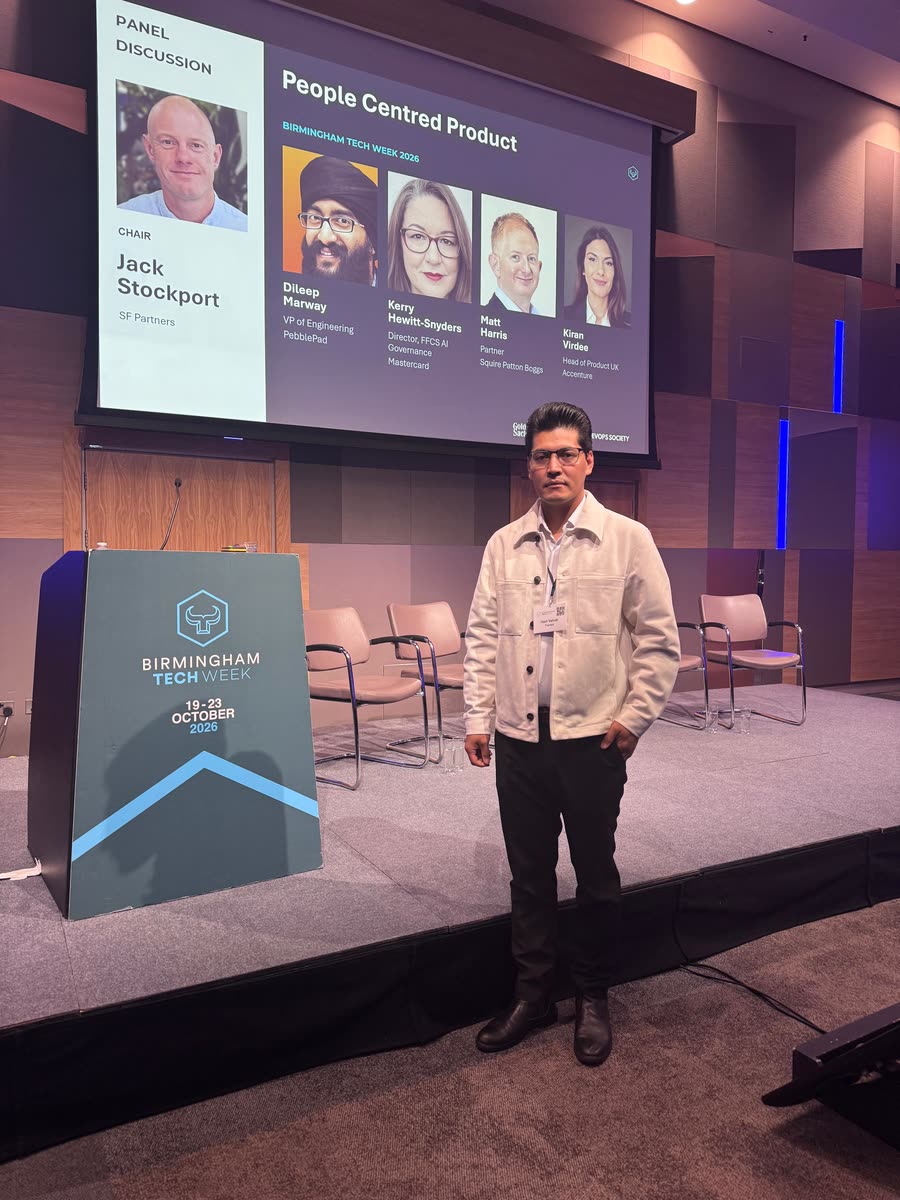
If Wednesday said your customers will arrive with agents, Friday asked what those agents will find when they get there. Akash's own summary afterwards was to "build a good foundation for your APIs so the easy parts can be automated away", and then put your effort into the hard parts. Before the talk, he had made the point that the server has to enforce permissions, not the agent. Jemima Orakwue, who wrote up the day, took three things from it: clear contracts, deliberate boundaries and testing.
In the afternoon, Cynthia Akiotu of Accenture took the security side, in "From Prompt Engineering to Agent Engineering: Securing AI Agents that can take action".
None of this is new to anyone who has validated a form on the server. What changes is the scale, and the persistence. A person gives up after two failed attempts. An agent will try every route your API allows, at any hour, for someone who expects it to work. So the dull parts get promoted: exact error messages, writes that are safe to retry so a timeout never books the same slot twice, permissions checked on every call, and rate limits that assume a machine on the other end. Tom's WhenIsBins already publishes a guide addressed to agents. I suspect that becomes normal sooner than most of us expect.
05 Generating code is not engineering
Robert Bilsland's afternoon keynote was about vibe coding, and the warning I took from it was a simple one. The speed hides the risks: edge cases nobody tested, security holes, and code that nobody fully understands or can safely maintain. Getting code out of a model is one thing. Engineering is another.
Earlier, Nick Heap and Astrid Bowser of OneAdvanced had asked "You build it, you run it, who buys it?", about product and engineering working much more closely. Jemima's takeaway from that one: "You can build something that works and still solve the wrong problem."
I use AI coding tools every day, and I'm faster for it. What they haven't removed is the reading. Someone still has to understand each change, and that someone gets the call when it breaks. For a prototype on a Saturday afternoon, vibe away. For a client's booking system, generated code is a draft until a person has read it.
The programme didn't pretend there was one right answer, either. It put Faith Sodipe of Bauer Media on at 2pm with a talk titled "You do not need Kubernetes: How we scaled our API layer without the Infrastructure Theatrics", while in another room Steve Wade was running a half-day Kubernetes workshop on "real clusters, nothing simulated". I liked that.
06 The human API
Steve Wade had opened the morning with "The Human API", a hands-on session on communication for engineers. His own summary of the problem: "Fluent in six languages. Frozen when a person asks a question." Funny, and fair.
The closing panel, "AI in Practice", chaired by Yiannis Maos, kept coming back to people too. Chris Waller of Fleetclear told leaders to go back to their teams and set aside proper time to learn and build together; training people and getting them comfortable with the tools is, as he put it afterwards, "the first rung on the ladder". Neil Mountford of Habito expects engineering roles to change a lot, and said curiosity, enthusiasm and critical thinking matter as much as ever. Suraj Sudera of Seergrills and David Francis of Under the Hammer completed the panel.
The best question of the week came from the audience rather than the stage. Jemima, a recent Computer Science graduate, worried in her write-up that if AI takes over the implementation work juniors used to learn on, the judgement that makes a good engineer may never get the chance to form. She ended with this:
"Are we changing how we build software faster than we're changing how we develop software engineers?"
I don't have a full answer. The closest I've got is Chris's: learning time has to be planned, not squeezed in around delivery. And people early in their careers need real decisions to make, not just output to approve.
07 Also from the week
On the Wednesday, the science minister Chris McDonald named OrthoHeal, an Indian company that makes flexible, water-resistant casts, winner of the government-backed Scale-Up Games. Ten growing businesses from Europe, Asia and Africa had competed to make the UK their base, and the prize includes nine months of workspace and help entering the UK market.
On Friday night the week closed with the Black Tie Dinner and Tech Awards at the ICC, 400 people according to the conference's host, Ben Whitmarsh. EvoPhase, a University of Birmingham spin-out that uses evolutionary AI to optimise industrial designs, was named Frontier Tech Champion, and its co-founder Professor Kit Windows-Yule won Tech Leader of the Year. Lisa Ventura MBE won Diversity Champion. FlashAcademy, GP Triage and Christian Nwachukwu were among the other winners.
08 What I'm taking back to my desk
- Test my own booking flows with an AI assistant, and watch where it gets stuck, or worse, where it gets through when it shouldn't.
- Build every API as if an agent will call it: exact errors, retries that can't double-book, permissions on the server, limits that assume a machine.
- Keep reading every AI-generated diff before it ships.
- Put time in the diary to play with the tools, as Tom said, and to talk to the people who use what I build, as Steve would.